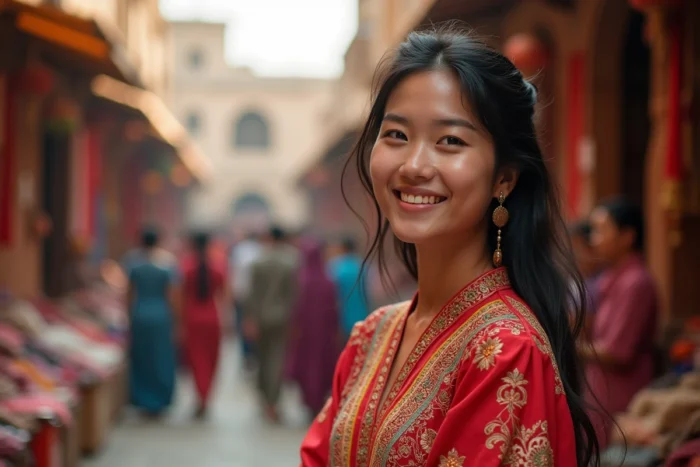
Rankings of countries by female beauty are proliferating on social media and in lifestyle press. Lists of ten, twenty, or fifty nations, often accompanied by retouched photos and terse comments, these rankings generate millions of views. Their methodology, when it exists, relies on online voting or the opinion of a single editorial team. The subject deserves a more careful examination than the simple enumeration of countries.
AI Filters and Image Retouching: Distorting the Perception of Beauty by Country
Before even discussing any ranking, a technical observation must be made. Applications like Facelab now allow users to smooth skin, refine noses, or enlarge eyes in just a few seconds. The gap between online appearance and physical reality has never been wider.
When a ranking relies on photos published on Instagram or TikTok, it does not measure the beauty of a population. It measures a composite of genetics, makeup, lighting, and algorithmic retouching. Access to these tools varies by country: a fast connection, a recent smartphone, and a developed digital culture are enough to transform the visual representation of an entire nation.
A country where influencers heavily use filters will mechanically appear higher in a survey based on images. In contrast, a country with less digital penetration will be underrepresented, regardless of the actual appearance of its women. Rankings of female beauty reflect access to retouching more than physical reality.

Several media outlets have documented a ranking of countries by female beauty listing nations such as Brazil, Russia, Sweden, or Ukraine. These lists resemble each other from site to site, reproducing the same stereotypes without ever specifying the data on which they are based.
Criteria for Female Beauty: A Cultural Construction, Not a Universal Constant
International beauty contests, from Miss World to Miss Universe, offer a standardized format with recurring scoring criteria: facial symmetry, silhouette, poise. This unique grid poses a problem.
In Africa, media outlets like TV5Monde remind us that historical beauty criteria varied deeply among peoples. Body shapes, skin tone, scarifications, traditional hairstyles: each culture valued different attributes. Current standards, more homogeneous, are largely linked to globalization and Western influence.
Ranking female beauty by country amounts to applying a single reading grid to incompatible cultural realities. What Sweden considers an aesthetic ideal does not correspond to the canons valued in Lebanon, Colombia, or South Korea.
- In South Korea, the cosmetics industry pushes towards an ideal of luminous skin and fine features, amplified by K-pop culture and accessible cosmetic surgery.
- In Brazil, ethnic mixing produces a diversity of physiques that rankings often reduce to a single model archetype.
- In Russia or Ukraine, the recurring presence in rankings is as much due to the visibility of models in the fashion industry as to a measurable criterion.
- In Sweden, the reputation rests on a persistent stereotype (tall, blonde, blue-eyed) that does not reflect the current demographic diversity of the country.
Methodology of Global Beauty Rankings: Online Votes and Selection Bias
The majority of rankings published online are not based on any scientific protocol. The magazine U City Guides, often cited, offers an editorial ranking without a representative sample or explicit criteria. Votes on Facebook or Instagram suffer from massive biases: countries with the most active digital communities mechanically gather more votes.
No public ranking is based on a controlled experimental protocol. An ongoing study at the University of Conakry in Guinea is attempting a different approach: presenting faces to panels, standardized rating scales, analyzing the influence of skin color on attractiveness perception. This type of academic work, limited to one country, contrasts with global lists that claim to cover the entire world without comparable rigor.

The available data do not allow us to conclude that one country produces objectively more beautiful women than another. However, they do document which aesthetic standards dominate at a given time and through which channels they spread.
Geographical Bias in Modeling and Fashion Contests
The modeling industry concentrates its castings in a few capitals: Paris, New York, Milan, São Paulo. Countries close to these centers of gravity benefit from overrepresentation in fashion media. A Brazilian or Ukrainian woman statistically has a better chance of being spotted by an agency than a woman from a country without international fashion infrastructure.
This visibility creates a halo effect: countries that export models are perceived as harboring the most beautiful women, while the causal link is the reverse. It is the industry that selects according to its own criteria, not the population conforming to a standard.
Female Beauty and Globalization: Towards a Homogenization of Standards
Social media accelerate the convergence of aesthetic ideals. Beauty trends circulate in just a few hours from one continent to another. The contouring popularized in the United States, Korean skincare routines, makeup techniques disseminated by Brazilian influencers: everything blends in a continuous flow.
- Retouching applications offer filters calibrated to a homogeneous ideal (smooth skin, fine nose, enlarged eyes), regardless of the user’s country.
- National beauty contests are gradually adopting criteria aligned with international standards, reducing the place of local particularities.
- Cosmetic surgery, expanding in countries like South Korea or Brazil, pushes towards a uniformity of features considered attractive.
The globalization of standards makes country-by-country rankings increasingly artificial. If all women in the world have access to the same tools for physical and digital transformation, the notion of national beauty loses its substance.
Rankings of female beauty by country function as viral content, not as analyses. They reflect media visibility, access to retouching technologies, and the persistence of cultural stereotypes. Beauty remains a situated cultural fact, not a competition between nations.