
Creative stationery encompasses all writing, organizing, and decorating supplies designed for personalized use: notebooks, planners, patterned papers, office accessories. When these products claim an eco-friendly dimension, they rely on material choices (recycled paper, vegetable inks, certified wood) and manufacturing practices (short supply chains, small batches). Since the European regulation PPWR came into effect on August 12, 2026, these environmental claims are regulated much more strictly than before.
Environmental Claims and Stationery: What the Law Now Prohibits
Displaying “eco-friendly” or “zero waste” on a notebook or packaging is no longer just a marketing argument. The European regulation on environmental claims requires that each mention be verifiable, specific, and based on a documented life cycle.
Specifically, a stationery brand can no longer write “eco-friendly paper” without specifying what that entails. Vague terms like “natural” or “green” without proof are now prohibited. The framework aims to protect consumers from greenwashing, including on product sheets of online stores.
For creators selling notebooks, planners, or office accessories, this means revising each commercial description. Among the shops offering artisanal creative stationery, marie-carotte.fr exemplifies this segment of independent brands directly affected by these new transparency requirements.
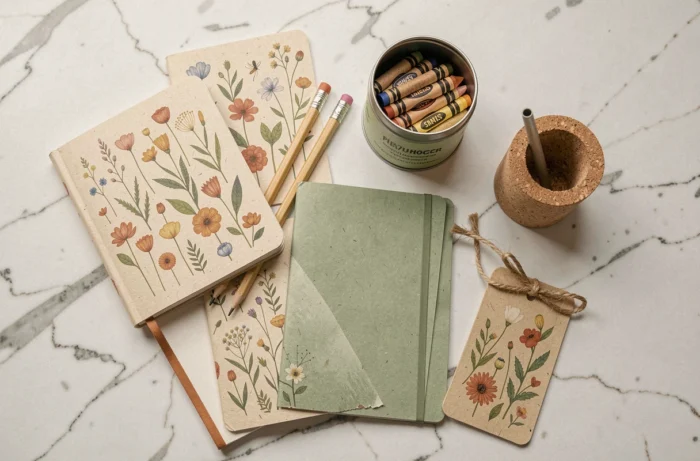
Paper Labels: FSC, PEFC, and European Ecolabel Facing Real Requirements
The majority of papers sold in creative stationery carry an FSC or PEFC certification. These labels guarantee that the fiber comes from sustainably managed forests. The specialized press reminds us in 2026 that these certifications alone do not cover the overall impact of paper over its entire life cycle.
The European Ecolabel is described as more comprehensive, as it includes manufacturing, water emissions, energy consumption, and bleaching. An FSC-certified notebook with a plastic-coated cover and shrink-wrapped packaging sends a contradictory message.
What a Label Covers and What It Does Not
- FSC and PEFC certify the origin of the raw material (wood, fiber) but not the transformation process or the packaging of the finished product
- The European Ecolabel evaluates the life cycle, including inks, glues, and surface treatments applied to the paper
- None of these labels guarantee the actual recyclability of the finished product if it combines paper, plastic, and metal (spiral binding, hot foil stamping)
For a collection of notebooks made from recycled paper, the choice of label directly conditions what can be legally stated on the product sheet. A partial label does not justify a global claim.
Creative Stationery Packaging: PPWR and REP, Concrete Constraints for 2026-2027
The PPWR (Packaging and Packaging Waste Regulation) has been in effect since August 12, 2026. For brands that ship orders (notebooks, gift boxes, accessories), every professional packaging falls under this regulation.
At the same time, the REP (extended producer responsibility) for professional packaging requires brands to contribute financially to collection and recycling. The payment schedule is delayed, but compliance remains mandatory starting now.
What This Changes for a Stationery Shop
The kraft paper used to wrap a handmade notebook is considered packaging under the PPWR. A reusable fabric pouch is also considered packaging if provided with the product. Each packaging component must be identifiable by the consumer for sorting.
Brands using mixed packaging (like a cardboard box with a plastic window, for example) will need to either remove the plastic or document the recyclability of each material separately. Decorative over-packaging, common in stationery gift sets, becomes a full compliance issue.

Recycled Paper, Vegetable Inks, and Certified Wood: Building a Coherent Selection
A coherent range of eco-friendly stationery goes beyond the choice of paper. The complete chain includes: weight, binding, ink, glue, surface treatment, and packaging.
A recycled paper notebook bound with non-recyclable glue undermines the entire approach. Vegetable inks (made from soy or flax) reduce volatile organic compounds during printing, but their availability in small batches remains a barrier for independent creators.
Points of Caution for a Responsible Collection
- Prefer sewn or stapled bindings over metal spirals, which complicate the recycling of the finished product
- Ensure that the recycled paper used has a documented post-consumer fiber rate, not just reclassified industrial scraps
- Avoid surface treatments (glossy lamination, UV varnish) on covers if the goal is recyclability in paper-cardboard streams
- Document each material choice on the product sheet to remain compliant with claims regulations
The 5-stream sorting in companies, which requires separating paper, cardboard, plastic, glass, and metal in organizations, reinforces this logic. A stationery product intended for the B2B market must be designed from the outset to fit into this collection circuit.
Eco-friendly creative stationery is no longer just an aesthetic promise. Since 2026, every word on a package, every displayed label, and every chosen material legally commits the brand. Creators who document their technical choices precisely have a real advantage over those who settle for generic formulas, as compliance itself becomes a differentiating argument.