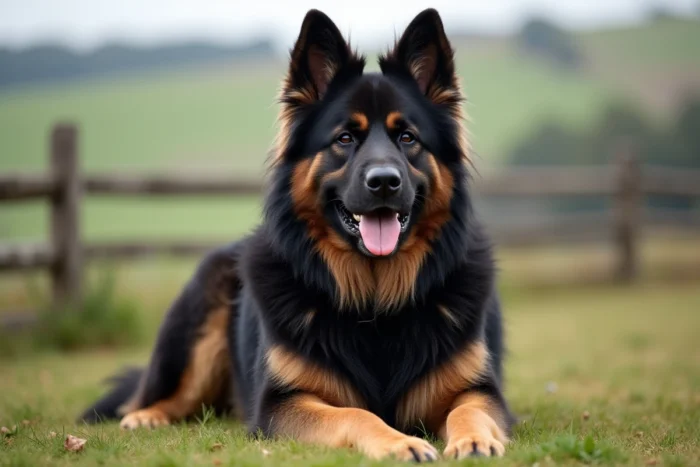
The German Shepherd mixed with Newfoundland is a large hybrid that combines two breeds with very different abilities: one oriented towards herding and guarding work, the other towards water rescue and pulling. This crossbreed produces a dog whose adult size, activity level, and joint vulnerabilities often exceed what future owners anticipate.
Structure and Growth of the German Shepherd-Newfoundland Mix
Articles on the parent breeds detail temperament or history but quickly overlook a critical point: managing bone growth. A German Shepherd-Newfoundland mix reaches an adult weight significantly higher than that of a standard German Shepherd, with a build that often borrows the Newfoundland’s broad chest and bone density.
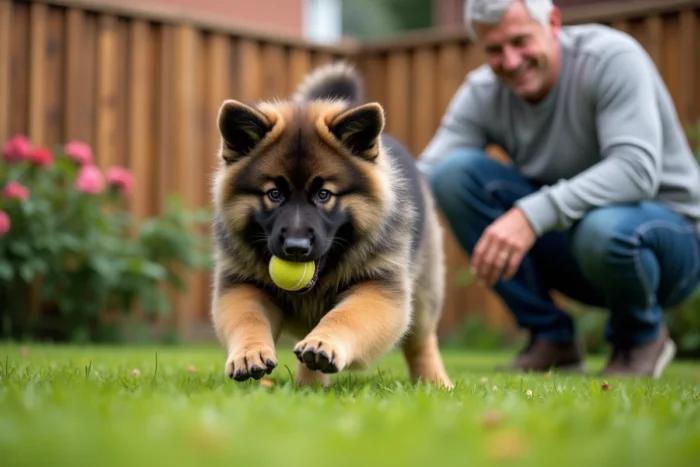
This rapid growth necessitates limiting intense exercise until skeletal maturity is complete, which can extend well beyond the first year. Repeated jumps, frequent stairs, and running on hard surfaces put stress on still fragile joints. Adapting the puppy’s lifestyle to its physiological reality, rather than its apparent energy, reduces the risk of early injuries.
The coat varies depending on parental dominance: a dense, medium to long hair, often double, requiring regular grooming. The undercoat inherited from the Newfoundland makes shedding particularly abundant, with two marked seasonal peaks. Brushing several times a week remains the norm to prevent tangles and monitor skin condition.
To better understand the morphological and behavioral specifics of this hybrid, a complete sheet on the German Shepherd-Newfoundland mix on La Maison des Animaux details the traits inherited from each parent breed.
Temperament of the Mix: Protective but Not Naturally Obedient
The German Shepherd brings natural vigilance and sustained work capacity. The Newfoundland imparts a deep attachment to the family unit and a relative calm indoors. The combination results in a dog with a protective temperament that requires early and ongoing socialization.
Without regular exposure to varied environments from the first weeks, this mix can develop marked distrust towards strangers, amplified by its imposing size. Socialization should not be limited to the first weeks with the breeder; it must continue actively throughout the dog’s adolescence.
Obedience does not come naturally with this type of crossbreed. The German Shepherd responds well to structured commands, but the Newfoundland may introduce some inertia to repetitive orders. It is essential to vary exercises and keep sessions short. A reliable recall is built over several months, not in just a few sessions.
Coexistence with Children and Other Animals
This mix generally shows patience with children, provided it has been accustomed to their presence early on. Its size remains the primary risk factor: a sudden movement or overly vigorous play can unbalance a child without any aggressive intent from the dog.
Coexistence with other dogs works best when established from a young age. An unneutered male, once adult, may exhibit a tendency towards spatial dominance, especially in confined spaces.
Health of the German Shepherd-Newfoundland Mix: Joint and Cardiac Risks
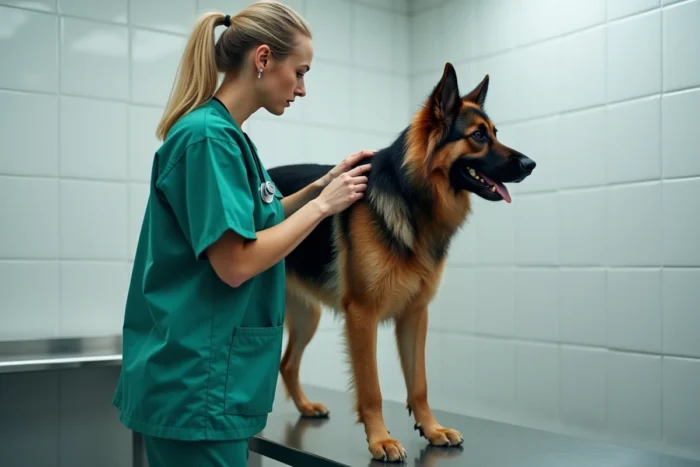
Both parent breeds share a predisposition to hip dysplasia, making this risk particularly high in the mix. The Newfoundland adds vulnerability to cardiac pathologies, notably aortic stenosis. The German Shepherd, on the other hand, may transmit digestive sensitivity and a tendency towards degenerative myelopathy.
- Hip and elbow dysplasia: have breeders radiograph the parents before any mating, and request parental scores from the breeder
- Hereditary cardiac pathologies: an echocardiographic examination of the parents reduces the risk of transmitting valve malformations
- Gastric dilatation-volvulus: common in deep-chested dogs, it requires meal portions to be divided and exercise to be avoided immediately afterward
- Overweight: weight control is the most effective preventive measure to preserve joints and heart health in the long term
Feeding must be adapted to each growth phase. An excess of calcium or too high caloric intake during the first year accelerates bone growth without allowing cartilage the time to solidify.
Breeding Advice and Choosing a Breeder for This Mix
This type of crossbreed is not recognized by official registries like the LOF in France. Therefore, there is no breed standard or mandatory tests governing reproduction. The responsibility for health screening lies entirely with the breeder.
A serious breeder conducts at least dysplasia tests on both parents, offers a cardiac examination for the Newfoundland parent, and provides results without needing to be asked. The absence of these documents is a clear warning sign.
What to Check Before Acquisition
- The dysplasia test results (hips and elbows) for both parents, with official reading
- A recent cardiac examination of the Newfoundland parent, ideally performed by a specialized veterinarian
- The living conditions of the puppies during the first weeks: a puppy raised in isolation in a closed kennel will have a socialization deficit that is hard to make up for
- The temperament of the parents, observable during an on-site visit
Shelters and associations report an increase in the abandonment of large mixed breeds like shepherds or mastiffs after adolescence, often because the adult size and daily needs have been underestimated. For a German Shepherd-Newfoundland mix, the peak of abandonment typically occurs between one and two years, when the dog reaches its adult size and veterinary and food costs become tangible.
Adopting this type of dog without having anticipated the necessary space, annual health budget, and daily exercise time leads to a dead end. A well-prepared large mix is a remarkable companion; poorly anticipated, it ends up in a shelter.