When receiving a notarial deed mentioning a parcel of 2 ha 35 a 17 ca, the first reaction is often to look for its equivalent in square meters. This reflex occurs with every land transaction, every sales agreement, and every land registry check. The conversion of hectares, ares, and centiares into square meters relies on a simple mechanism, but comma errors can be costly on land.
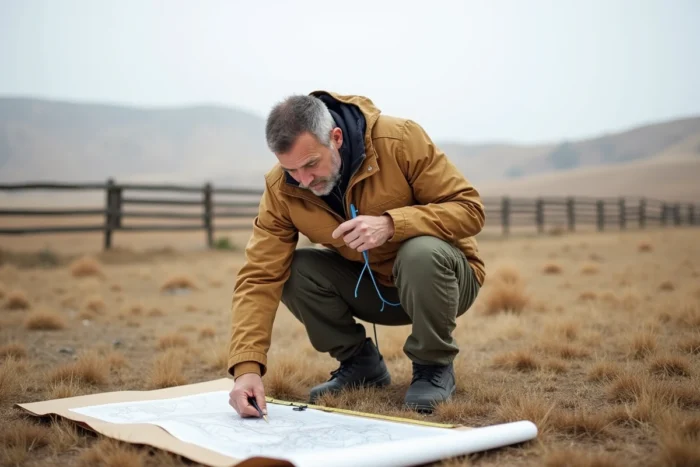
Measuring an irregular parcel before converting
Conversion articles assume that the area is already known. On the ground, this is not always the case. Many agricultural parcels or building plots do not have a rectangular shape, and the area indicated on an old deed may differ from the measurable reality.
The most accessible method without a surveyor is to decompose the land into rectangles and triangles. You measure each segment, calculate the area of each geometric shape, and then add them up. For a triangle, you multiply the base by the height and divide by two. For a rectangle, length times width.
Today, many individuals use the measuring tool integrated into Google Maps to place points at the corners of a parcel and obtain an area in square meters. This allows for a quick verification of a cadastral data before proceeding to the conversion of hectares, ares, and centiares stated in a sales deed. The result remains approximate (the accuracy depends on the quality of the positioning of the points), but it is a useful first filter.

Hectare, are, centiare: the logic of conversion to square meters
The system is decimal, making it more predictable than it seems. Each unit is derived from the previous one by a factor of 100.
- One centiare (ca) equals one square meter. It is the base unit that everyone understands.
- One are (a) equals 100 square meters, or a square with sides of 10 meters.
- One hectare (ha) equals 10,000 square meters, or a square with sides of 100 meters.
To convert an area expressed in ha, a, and ca, we apply the following formula: area in m² = (ha x 10,000) + (a x 100) + ca. Let’s take the example of a parcel of 2 ha 35 a 17 ca. The calculation gives: (2 x 10,000) + (35 x 100) + 17 = 23,517 m².
The classic mistake is to forget the factor of 100 between each level. You move from ca to a by multiplying by 100, then from a to ha by multiplying again by 100. The direct transition from ca to ha thus involves a factor of 10,000.
Converting in the other direction: from square meters to ha, a, ca
You start with the total number of square meters. Divide by 10,000 to get the whole hectares. The remainder is divided by 100 to extract the ares. What remains are the centiares.
Example: 8,742 m². Divided by 10,000, you get 0 ha (the number is less than 10,000). Divided by 100: 87 ares, remainder 42. Result: 0 ha 87 a 42 ca. On a notarial deed, you would write 87 a 42 ca.
Buildable land: why these conversions matter daily
Authentic deeds in France systematically express land areas in hectares, ares, and centiares. This is a notarial practice, not an obligation of the International System of Units (which uses square meters). This convention creates a permanent gap between the language of deeds and the common understanding of areas.
When comparing real estate listings, some display the area in square meters, while others use ares or hectares. Without mastering the conversion, one can misjudge a piece of land. A lot of 4 a 50 ca is 450 m², which is a modest size for a single-family home. A lot of 12 a is 1,200 m², allowing room for a garden and outbuildings.
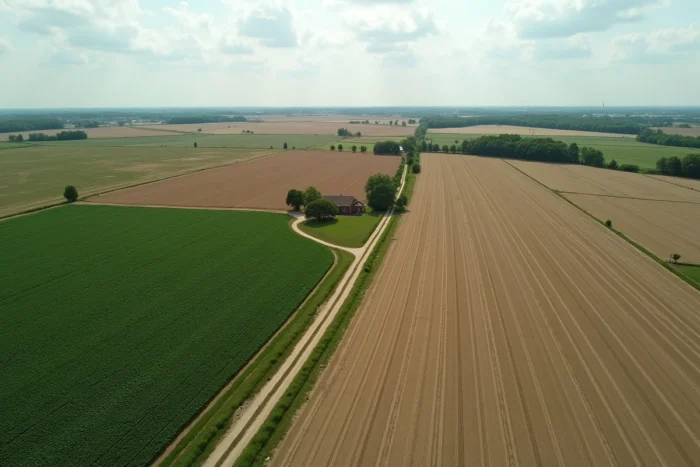
Recent trends show that the average size of plots purchased for building a single-family home is decreasing. People are buying smaller parcels than a few years ago, making precise reading of areas even more critical. A few dozen centiares less can change the feasibility of a project when the land is already compact.
Common pitfalls and practical checks
The first pitfall is the confusion between are and acre. The acre is an Anglo-Saxon unit that has nothing to do with the are. One acre represents a much larger area than one are. On online conversion tools, simply selecting the wrong unit can yield an absurd result.
The second pitfall concerns rounding in old deeds. Some cadastral documents date back several decades and mention areas rounded to the nearest are. If you buy a parcel of 3 ha 20 a (according to the deed), the actual area may vary by a few dozen square meters compared to the theoretical 32,000 m². A boundary survey by a licensed surveyor remains the only way to obtain a legally binding measurement.
- Check that the source unit is indeed in ares (a) and not in acres before any conversion.
- Cross-check the area of the deed with the cadastral plan available on the land registry website.
- For irregular parcels, request a contradictory boundary survey rather than relying solely on Google Maps or an old survey.
Feedback varies on the reliability of free online tools: some round to the nearest square meter, while others truncate. For notarial or banking use, it is better to perform the calculation yourself using the basic formula and cross-reference with the official document. Conversion remains a basic arithmetic operation, but it is its verification on the ground that makes the difference between a controlled purchase and an unpleasant land surprise.