Relaxation refers to a set of practices aimed at reducing the activation of the sympathetic nervous system, which triggers stress responses. The resulting muscle relaxation and slowing of the heart rate are not just simple sensations of comfort: they reflect a measurable shift towards the parasympathetic nervous system, responsible for physiological recovery.
Vagus nerve and slow breathing: the central mechanism of relaxation
Before choosing a technique, understanding the role of the vagus nerve helps distinguish effective methods from placebo effects. This nerve, the longest in the autonomic nervous system, connects the brainstem to the digestive organs, heart, and lungs. When stimulated, it triggers a slowing of the heart rate and a decrease in muscle tension.
Slow breathing, paced around six breaths per minute, is one of the most direct ways to stimulate this nerve. The principle relies on a slightly longer exhalation than inhalation, which amplifies vagal tone. Specialized sources in stress management describe this rhythm as a tool for modulating the autonomic nervous system, far beyond a simple calm exercise.
This mechanism explains why heart coherence works so well in just a few minutes: it directly targets this vagus nerve – heart – breathing loop. A useful framework for exploring different approaches is available at https://wikirelax.eu/, which gathers sheets on relaxation practices and their foundations.
Choosing a relaxation technique based on the dominant symptom
Competitors often list techniques (yoga, sophrology, meditation) without specifying which is suitable for which profile. The approach based on the dominant symptom is more practical.
Mental agitation and looping thoughts
When the main issue is a restless mind that won’t stop, body-centered techniques yield better results than silent meditation, which can amplify rumination in beginners. Progressive muscle relaxation, which involves contracting and then releasing each muscle group in sequence, forces attention towards concrete physical sensations.
Sensorial anchoring is another quick option. The 5-4-3-2-1 method engages the five senses by asking to identify five visual elements, four tactile sensations, three sounds, two smells, and one taste. It diverts the flow of thoughts in just a few minutes, making it usable between meetings or during commutes.
Muscle tension and diffuse pain
For individuals whose stress manifests primarily in the body (stiff neck, clenched jaw, raised shoulders), breathing techniques alone are not always sufficient. Gentle yoga or body scanning, which involves mentally reviewing each area of the body to identify contractions, are more suitable.
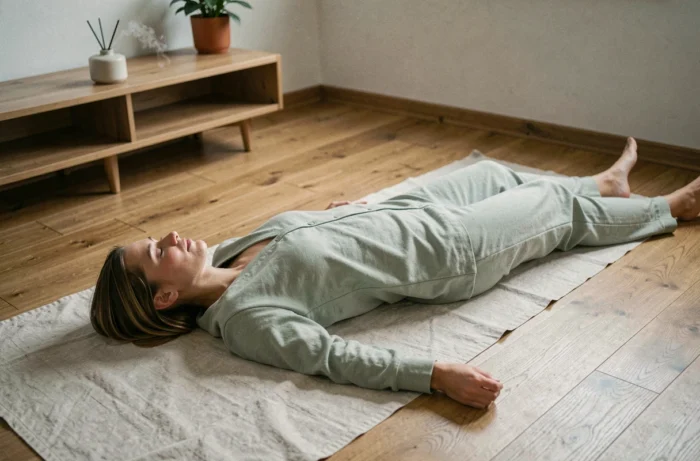
Body scanning is practiced lying down, slowly moving up from the feet to the top of the head. Each area identified as tense receives attention for a few seconds, coupled with a prolonged exhalation. The session rarely lasts more than ten minutes.
Nervous fatigue and sleep disorders
Heart coherence practiced in the evening reduces the time it takes to fall asleep for many stressed individuals. The protocol remains the same (six cycles per minute, extended exhalation), but regularity matters more than duration. A few minutes before bedtime is sufficient when practiced daily.
Express relaxation: short formats for daily stress
The idea that a relaxation session requires thirty minutes in a calm environment deters many beginners. Formats of two to five minutes produce measurable effects on heart rate and muscle tension, provided that only one exercise is targeted per session.
Three short formats that work in professional or family contexts:
- Square breathing (inhale for four counts, hold for four counts, exhale for four counts, hold for four counts) is practiced sitting, with eyes open, without attracting the attention of those around.
- Contraction-relaxation of the hands and shoulders, held for five seconds and then released suddenly, eases accumulated tension in front of a screen.
- The 5-4-3-2-1 anchoring described above, which requires no equipment and can be done standing or sitting.
The key is not duration but frequency. Two to three micro-sessions spread throughout the day produce a cumulative effect on vagal tone, whereas a single long weekly session does not sustainably alter the stress response.
Limits of relaxation and complementarity with professional support
Relaxation effectively manages daily stress and occasional tension. It does not replace medical or psychological support when anxiety, sleep disorders, or chronic pain have persisted for several weeks.
Several recent sources emphasize this framing: relaxation is a complementary aid, not a standalone solution. A person who practices heart coherence every evening but continues to suffer from insomnia after a month would benefit from consulting a healthcare professional rather than multiplying techniques.
This positioning does not diminish the usefulness of the exercises described. It simply delineates their scope of action. Breathing practices, muscle relaxation, and sensorial anchoring remain among the most accessible tools for regaining a state of relaxation daily, without equipment, subscriptions, or side effects.