
Size 50 for men often appears in fashion guides without the logic behind this number being clearly stated. It is based on a standardized calculation on a European scale, and its equivalents vary depending on the type of clothing, the cut, and the country of origin. Understanding what this size precisely entails helps avoid purchasing mistakes, especially online where trying on is not possible.
Size 50 men: centimeter equivalents for tops and bottoms
The European standard EN 13402 establishes a simple principle for tops: the size corresponds to the chest circumference divided by two. Therefore, a size 50 indicates a chest circumference of about 100 cm.
For bottoms (pants, chinos, jeans), size 50 refers to a waist circumference of around 84 to 90 cm depending on the brands. The inseam, however, is not coded in this number and must be measured separately.
| Body Measurement | EU Size 50 (tops) | EU Size 50 (bottoms) |
|---|---|---|
| Chest Circumference | Approximately 100 cm | – |
| Waist Circumference | – | 84 to 90 cm |
| International Equivalent | M to L depending on brands | US 34 to 36 |
| Letter Equivalent | Upper boundary of M / lower boundary of L | L or even XL depending on systems |
This table highlights a point that brand guides often overlook: size 50 does not neatly fall into a single category (M or L). It is precisely at the boundary, which explains the frequent hesitations when choosing.
To delve deeper into the meaning of this measurement and its morphological implications, a dedicated article on size 50 men on Zazie Web details the equivalents according to several international systems.

Brand discrepancies: why a 50 doesn’t always fit the same
The number 50 gives an illusion of standardization. The EN 13402 standard does define measurement ranges, but brands are not required to apply it strictly. Each manufacturer adjusts its patterns according to its target market and positioning.
A concrete example: at some accessible ready-to-wear brands, size 50 is generously cut to flatter the silhouette and reduce returns. At suit or dress shirt brands, size 50 aligns more closely with theoretical measurements, or even fits slightly snug for a tailored look.
Cut and material: two often overlooked variables
The cut (regular, slim, oversized) radically alters the fit of the same size 50. An oversized t-shirt in size 50 may have shoulder width and torso length comparable to a regular size 54 at another brand.
The material also plays a role. A fabric with a high proportion of elastane allows for a few centimeters of leeway. In contrast, a 100% cotton poplin shirt leaves no margin: if the chest circumference exceeds the theoretical 100 cm, the fabric pulls at the buttons.
- A stretch jersey in size 50 generally fits a chest circumference up to 104 cm without discomfort
- A rigid shirt in size 50 assumes a chest circumference not exceeding 100-101 cm for a proper fit
- A structured jacket in size 50 often includes additional ease for layering
Taking measurements to ensure a 50 truly fits
Relying solely on the number on the label remains the primary source of error. Three measurements are enough to validate a purchase: chest circumference, waist circumference, and sleeve length for tops, waist circumference and inseam for bottoms.
Reliable measuring method
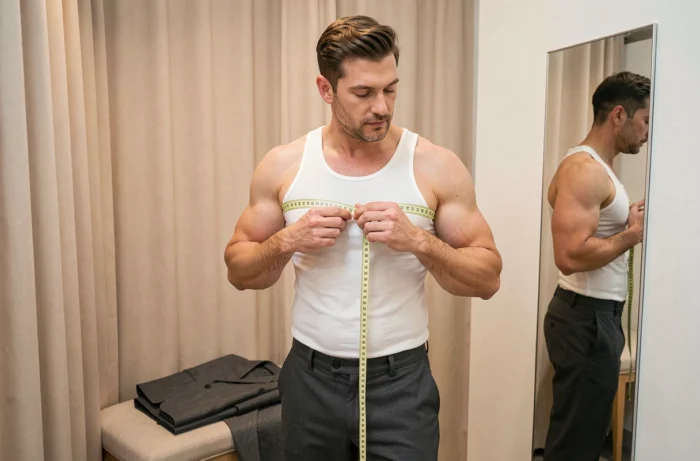
The measuring tape should be placed horizontally, directly on the skin or over a thin undergarment. For the chest circumference, it goes under the armpits and over the widest part of the bust. For the waist circumference, it is positioned at the level of the navel, without tightening or leaving slack.
Measure standing, relaxed, without sucking in the stomach: this detail can easily change the result by two to three centimeters. At the boundary between M and L, these centimeters determine the final choice.
- Chest circumference under 98 cm: size 48 (M) will likely be more suitable
- Chest circumference between 98 and 103 cm: size 50 corresponds to the right range
- Chest circumference over 103 cm: moving to size 52 (L) avoids the feeling of compression
Size 50 in men’s pants: waist circumference and US equivalent
Confusion is even more common for pants because two systems coexist. The European 50 corresponds to a US 34 or 36, depending on whether the brand rounds down or up. The US number indicates the waist circumference in inches, providing an additional reference for cross-checking data.
A waist circumference of 86 cm, the median value of the 84-90 cm range, converted to inches gives about 34 inches. American and British brands will therefore label this profile as 34. Some European workwear or sports brands will label the same profile as XL in their lettered grid, illustrating how the letter alone is not enough to identify the correct size.
For pants, the inseam complements the waist circumference. It is measured from the inside of the thigh to the ankle and usually varies between 76 and 86 cm for an average-height man. This data, often coded “L30” or “L32” in Anglo-Saxon systems, does not appear in the number 50 and must be checked separately.
Size 50 for men designates a specific morphological profile, located at the M/L junction, with a chest circumference close to 100 cm and a waist circumference around 84-90 cm. The number alone guarantees nothing: the cut, material, and manufacturer’s sizing system create discrepancies that are measured in centimeters, not labels.