
A student who spends their first weeks modeling a kitchen layout on SketchUp, then defending their choices in front of a practicing professional, experiences a different education than one who goes through lectures on the history of furniture. The difference lies less in the displayed curriculum than in the space given to experimentation, mistakes, and the joy of creating. It is in this area that some interior architecture schools are changing the game.
Learning interior architecture through tools before theory
The first year of study is still often associated with a dense theoretical foundation, with art history and academic drawing at the forefront. Several schools are reversing this logic by putting professional software in the hands of students right from the start. At Ynov Rouen, for example, licenses for the Adobe suite, ArchiCAD, AutoCAD, SketchUp, Twinmotion, Blender, Revit, or Dialux are integrated into the curriculum from the first year.
The gain is tangible: instead of drawing a plan in mental projection for six months before touching a screen, students model, make mistakes, and start over. Mastering the tool accelerates the trial-and-error loop, and it is this loop that encourages continued learning. Feedback varies on the actual level achieved by the end of the first year, but the principle remains the same wherever it is applied: produce early to understand quickly.
For those looking to thrive in an interior architecture school, this hands-on approach radically changes the relationship with studies. One no longer endures a program; instead, one engages with it by creating something.
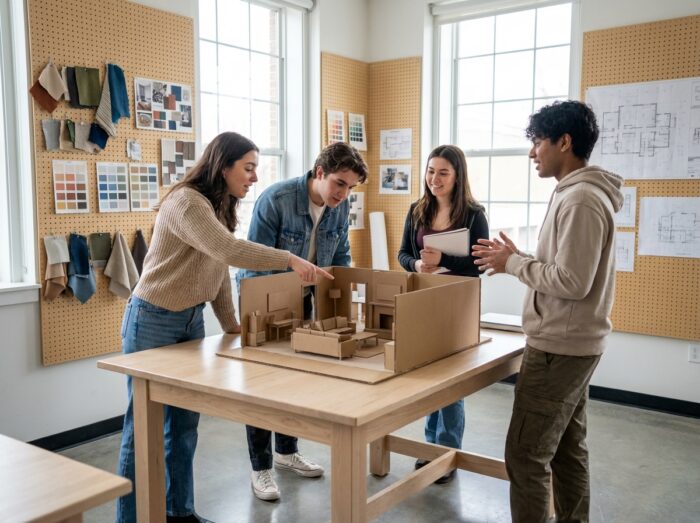
Work-study in design school: the back-and-forth that truly educates
Work-study has become a strong marker of training programs that recruit. The most common formats range from one week at school and two to three weeks in a company, or structured paths over twenty-four months. This rhythm shifts the center of gravity of learning: the campus is no longer the only training location; it becomes a space for reflection and synthesis.
On the ground, students learn things that no course covers. Managing a client who changes their mind at the last minute. Adapting a project to the constraints of a craftsman who cannot deliver on time. Negotiating a materials budget. These skills are not taught; they are experienced in real situations.
What work-study concretely brings to students
- A portfolio of projects completed under professional conditions, not just school exercises to show in interviews.
- An understanding of deadlines, costs, and trade-offs that working alone in a workshop does not allow one to acquire.
- A network of contacts (architects, craftsmen, suppliers) built during training, which facilitates insertion after graduation.
The work-study format also transforms the group dynamic within the school. Students returning from assignments share concrete experiences, which enriches their classmates’ projects. Teaching shifts from a vertical approach to a collective learning experience grounded in reality.
Career change in interior architecture: an adult audience changing the dynamics of schools
Interior architecture schools no longer only train eighteen-year-old high school graduates. Career change represents a growing influx of enrollees, with programs designed for adults leaving a first career. Some institutions offer specific curricula, sometimes in continuing education, to facilitate this transition without starting from scratch.
This mix of profiles alters the atmosphere of the classes. A former accountant entering space design brings a budgetary rigor that younger students may not yet possess. A former teacher transitioning to decoration poses different questions about the use of spaces. The diversity of backgrounds enriches collective projects and breaks the uniform class dynamic.
Climate challenges and renovation: the new playground of the curriculum
Interior architecture is no longer limited to choosing materials and colors. Training now integrates climate issues into their programs. The master’s program offered by MJM explicitly mentions the ability to “design, renovate, and manage” projects related to these challenges.
Renovating an existing building rather than constructing new ones becomes a full-fledged pedagogical exercise. Students learn to diagnose existing conditions, identify what can be preserved, and propose solutions that reduce environmental impact without sacrificing usability. This type of project pushes students to step away from a blank page, literally: they do not design an ideal space; they work with what is already there.

Choosing an interior architecture school: the criteria that matter in practice
In the face of the proliferation of training programs, one can get lost in brochures. A few points deserve particular attention before committing.
- The place of real projects in the curriculum: a school that has its students work exclusively on fictional assignments prepares them less well than a school that integrates projects for real clients or partners.
- Access to professional software from the beginning of the curriculum, with licenses included, and not just an introduction in the third year.
- The structure of work-study or long internships: a rhythm that allows for carrying a project from start to finish in a company is worth more than a series of short, fragmented internships.
- Consideration of renovation and environmental constraints in project topics, not just in an optional module.
A good indicator remains the type of projects presented by former graduates. If portfolios show only spectacular 3D renderings without any context of real constraints, the training may prioritize showcase over operational competence.
The interior architecture school that functions as a playground is not the one that promises the most creativity in its brochure. It is the one where students produce early, confront reality through work-study, and work on issues that go beyond decoration. The joy of learning comes from there: creating things that stand up, both literally and figuratively.