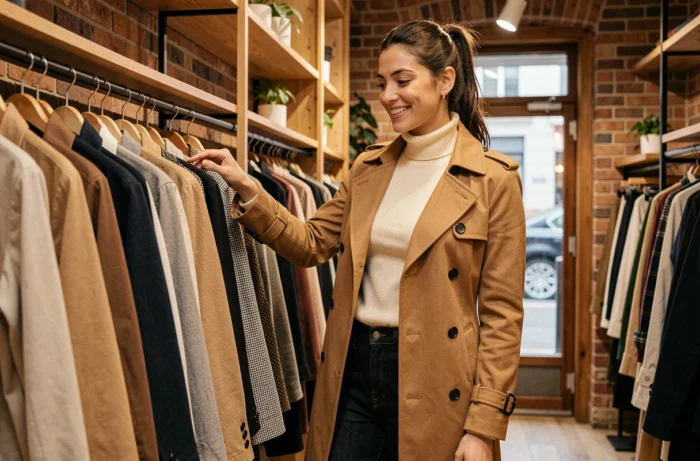
The fashion market produces more references than ever, but most consumers struggle to build a coherent clothing identity. An ASOS/Attest study from September 2026 involving 1,952 people confirms this: 64% believe that the industry offers too many options and too little advice on how to combine them. The problem lies not in the supply of pieces, but in the lack of a method to articulate them.
Algorithmic Micro-Trends and Style Uniformity
TikTok and Instagram feeds generate micro-trend cycles so rapid that most wardrobes end up looking alike. RTBF documented this phenomenon in August 2026: recommendation algorithms push the same silhouettes, the same palettes, and the same combinations to millions of users simultaneously. The result is a large-scale stylistic homogenization.
We observe that this mechanism creates a paradox. Users want a personal style but consume content that pushes them toward identical choices. According to the ASOS study, 86% state they want pieces that reflect their personal tastes, while 50% admit they struggle to build a distinct style identity.
To break this loop, algorithmic suggestions should be treated as a flow of raw inspiration, not as a prescription. Selecting a silhouette or palette spotted online and comparing it to one’s existing wardrobe remains the only way to filter out the noise. Exploring fashion on Mes Conseils Beauté provides access to insights that go beyond mere trend relay.

Building a Coherent Color Palette Without Superficial Color Analysis
Color structures a look more than cut. We recommend starting not from a fixed color season (spring, summer, autumn, winter), but from a practical two-step test.
First step: isolate three colors that you wear regularly and in which you receive spontaneous positive feedback. This unsolicited social feedback is a more reliable indicator than an online diagnosis based on a photo.
Second step: check the compatibility of these three colors with each other and with the neutrals in your wardrobe. A functional wardrobe relies on a simple ratio:
- Two to three basic neutrals (black, navy, off-white, heather gray, camel) that make up the majority of daily worn pieces
- Two to three signature colors used on the upper body or as accessories to visually anchor the silhouette
- One occasional, more saturated color reserved for statement pieces (a dress, a coat, a bag) that truly differentiates your wardrobe
This system reduces decision time in the morning and limits impulsive purchases of orphaned pieces. A garment that does not interact with any other piece in the wardrobe is a wasted purchase, regardless of its price or appeal on a hanger.
Fabrics and Draping: What Distinguishes a Mastered Look from a Rough One
The textile composition of a piece determines its drape, longevity, and how it interacts with the body in motion. Two white shirts of identical cut will give radically different silhouettes depending on whether they are made from tightly woven cotton poplin or fluid viscose.
Natural fabrics with a sufficiently dense weight (twill cotton, heavy linen, merino wool) maintain their structure better throughout the day. Synthetic blends with a high percentage of polyester move, cling, and lose their shape after a few hours. This is not an aesthetic judgment; it is a textile fact.
Reading the composition label before trying on saves time in the fitting room. We recommend a minimum threshold of 70% natural fiber for any structured piece (blazer, tailored pants, jeans). For fluid pieces (dress, blouse), a blend containing silk or cupro offers a drape that polyester alone cannot replicate.
The Crease Test as a Quick Indicator
Before buying, crumple the fabric in your fist for five seconds, then release. If the crease disappears within a few seconds, the material will perform well in real-life situations. If the crease remains marked, anticipate a garment that will require constant ironing or that will deform at friction points (elbows, sitting).
Accessories and Proportions: The Truly Differentiating Style Levers
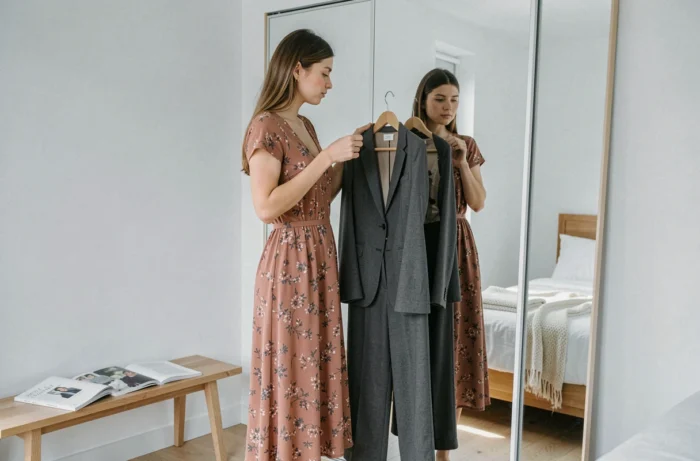
Competitors emphasize the scarf or belt as transformative accessories. The most underestimated lever remains the play of proportions between the upper and lower body. Wide pants paired with a fitted top do not produce the same effect as slim pants under an oversized blazer, even if both outfits use basic pieces.
The technical rule is simple: only one volume area per silhouette. Two simultaneous volumes (loose top and loose bottom) only work when a waist point marks the waist and creates a clear visual break. Without this anchor point, the silhouette loses its readability.
Accessories then come into play to adjust the message. A fine-cased watch, geometric earrings, or a structured bag each bring a different register. We advise against accumulating more than three visible accessories at the same time: beyond that, the eye doesn’t know where to focus and the style effect dilutes instead of strengthening.
- Shoes and bag in the same tone family (not necessarily identical) anchor the overall coherence
- One statement accessory per outfit is enough to create a focal point
- The belt worn over a fluid piece restructures the silhouette without changing garments
Personal style is built as much through subtraction as through addition. Removing an element from an outfit before heading out remains the most effective gesture to avoid visual overload. A wardrobe tightened around compatible pieces, reliable materials, and a mastered palette produces more relevant combinations than a closet full of isolated pieces bought over trends.