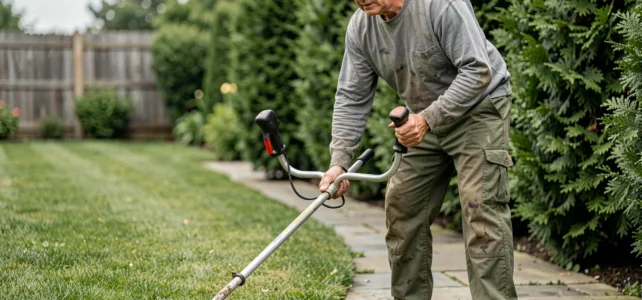
A thermal string trimmer is a portable tool equipped with a gasoline engine (two-stroke or four-stroke) that drives a rotating cutting head. Unlike wired or battery-powered electric versions, it operates without external power and generally delivers higher power. This autonomous operation makes it suitable for large or uneven terrains, where dragging an extension cord or recharging a battery becomes a real hassle.
Two-stroke or four-stroke engine: what changes for cutting
The choice of engine type determines both the available power, the weight of the device, and its long-term maintenance. A two-stroke engine operates with a gasoline-oil mixture. It is lighter, revs up quickly, and is cheaper to purchase.
A four-stroke engine, on the other hand, separates the oil circuit from the gasoline circuit. The torque is more consistent, vibrations are less pronounced, and fuel consumption is lower. In return, the device weighs more and its price increases significantly.
For a garden with classic borders (grass along paths or flower beds), a two-stroke is more than sufficient. The four-stroke becomes more interesting for larger areas where the working time exceeds half an hour, as the comfort of cutting over time makes a difference. The detailed specifications available on coupebordurethermique.fr allow for direct comparison of engine characteristics of common models.
Stage V standard and the future of thermal string trimmers
Since the gradual implementation of the European Stage V standard, the combustion engines of small gardening equipment must comply with much stricter particle and gas emission thresholds than before. This constraint directly affects thermal string trimmers.
According to a report by Mordor Intelligence, government restrictions on gasoline-powered handheld equipment, particularly in California and the European Union, are accelerating the transition to battery-powered products. Electric propulsion is described as “becoming the norm rather than an option.”
In practical terms, this means that the number of new thermal models available will decrease in the coming years. Manufacturers are directing their investments towards battery ranges, and some entry-level thermal string trimmers may be less well-supported in spare parts.
Buying a thermal model remains relevant, provided you choose a model from a brand that maintains a distribution network and a stock of consumables (spool lines, air filters, spark plugs). A device without available parts within two years becomes a dead weight.
Cutting width and line system: adapting the tool to the terrain
The cutting width refers to the diameter of the circle described by the rotating line. The larger it is, the more surface area each pass covers. On a thermal string trimmer, this width generally ranges from modest values for lightweight models to significantly larger diameters on semi-professional devices.
The diameter of the cutting line is just as important as the width. A thin line is suitable for soft grass, while a thicker line withstands dense grasses or tough weeds better. Some models accept plastic knife heads, useful for light brush but less versatile than a standard line spool.
Line feed: manual, semi-automatic, or automatic
The line feed mode determines the fluidity of the work:
- Manual feed requires stopping the engine to unwind the line by hand, which interrupts the work regularly.
- The semi-automatic system releases line when the cutting head is tapped on the ground, without stopping the engine.
- The automatic system continuously adjusts the line length without intervention. It is the most comfortable but also the most expensive and sensitive to jams if the line is not of good quality.
For regular use in a medium-sized garden, the semi-automatic system offers the best compromise between practicality and reliability. It is equipped on the majority of mid-range thermal models.
Weight, balance, and harness: comfort that makes a difference
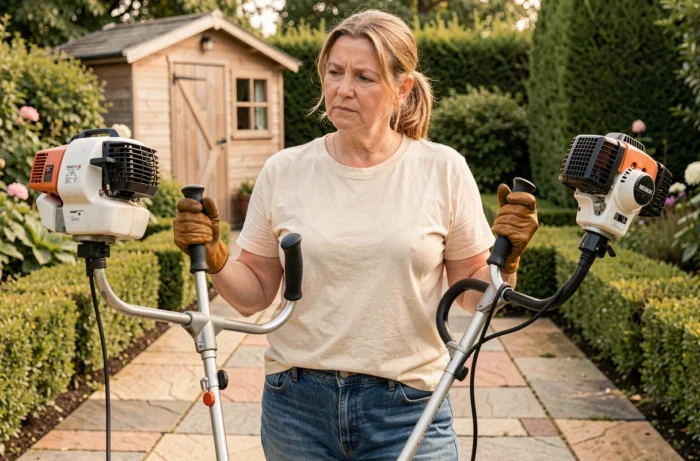
A thermal string trimmer weighs significantly more than an electric model. During work sessions of twenty minutes or more, muscle fatigue in the arms and back becomes a limiting factor.
Three elements determine the actual comfort of the device:
- The weight distribution between the engine (at the top or bottom of the tube) and the cutting head. An engine placed at the top facilitates guidance, while an engine at the bottom reduces lifting effort.
- The presence of a shoulder or carrying harness, which transfers the load from the arm to the torso. On a powerful thermal model, this is an accessory that should be considered essential.
- The diameter and coating of the secondary handle, often overlooked, but which affect the precision of guidance along the borders.
A telescopic tube adjustable in height prevents working bent over. If you measure more than one meter eighty or less than one meter sixty-five, check the adjustment range before purchasing: not all models adapt to extreme sizes.
Noise and thermal string trimmer: a real legal constraint
Garden thermal engines generate a noise level significantly higher than electric models. The codification of abnormal neighborhood disturbance in Article 1253 of the Civil Code now more strictly regulates noise nuisances between individuals.
Municipal decrees generally set time slots for the use of motorized gardening equipment. A thermal string trimmer used outside of these time slots is subject to penalties. Before investing, checking the authorized hours in your municipality is not a trivial precaution: it is a constraint that can render the device unusable on certain days.
For adjoining gardens in densely populated residential areas, this noise dimension sometimes weighs as much in the choice as power or cutting width. A powerful thermal model that can only be used a few hours a week loses some of its advantage over a quieter battery model that can be used at any time.