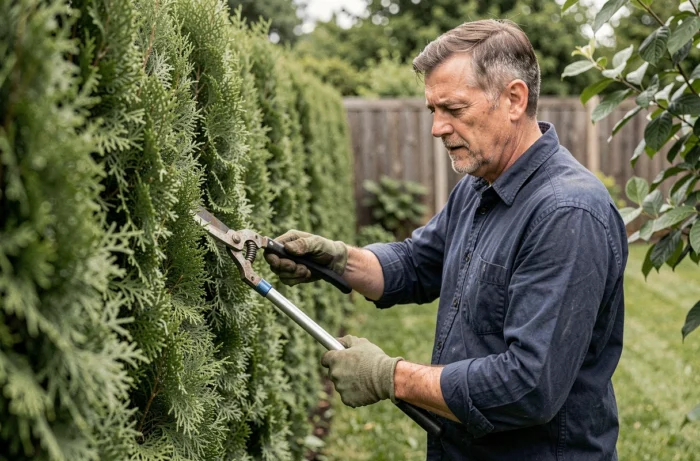
The size of a thuja hedge depends on two measurable variables: the calendar period and the depth of the cut. An error in either one produces visible damage within weeks, sometimes irreversible. Thuja does not regrow on old wood, making it a conifer that is both tolerant of light pruning and unforgiving of overly severe cuts. Understanding the differences between spring pruning and late summer pruning, between a superficial pass and a significant reduction, helps avoid bare spots that nothing can remedy.
Spring or late summer thuja pruning: comparison of results
The two commonly recommended pruning windows do not produce the same effects on the hedge at all. The table below summarizes the concrete differences between these two periods.
| Criterion | Spring pruning (April-May) | Late summer pruning (August-September) |
|---|---|---|
| Growth phase | Beginning of the vegetative peak, rapid regrowth | Slowdown in growth, moderate regrowth |
| Healing | Quick due to rising sap | Slower, but sufficient before winter |
| Risk of browning | Low if the cut remains in the green | Moderate in case of late cutting (October+) |
| Leaf density | High, branching multiplies | Limited, mainly maintaining shape |
| Bird nesting | Sensitive period (March-August) | End of period, reduced risk |
Spring pruning encourages densification. Late summer pruning serves to maintain the acquired shape and smooth out irregularities before winter. Knowing how to prune thujas correctly involves choosing the right window based on the desired outcome.
A single annual pass, done too late in the fall, exposes the hedge to frost on fresh cuts. Two prunings per year remain the most effective rhythm for a thuja planted in a hedge.
Cutting depth on thuja: the limit of old wood
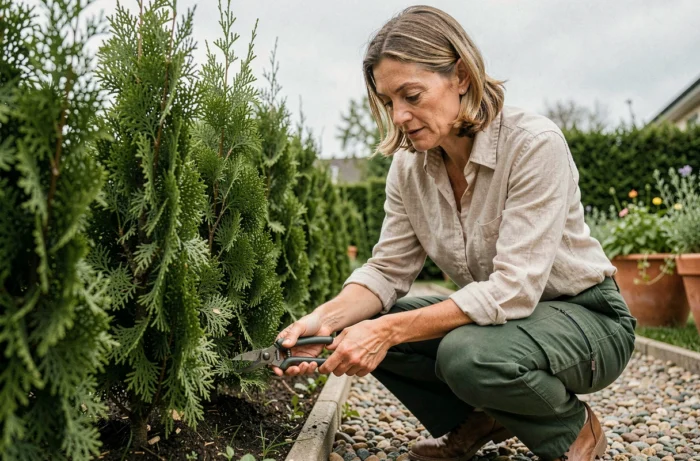
The most underestimated factor in thuja pruning concerns cutting depth. Thuja belongs to the conifers that do not regenerate buds on old wood. A branch cut beyond the green zone remains permanently bare.
Distinguishing green wood and old wood on a thuja branch
On a thuja twig, the green part corresponds to the shoots of recent years. It bears soft, colorful scales. Moving inward, the wood becomes brown, dry, and devoid of foliage. This is the boundary that should never be crossed.
- In maintenance pruning, only remove the current year’s growth, which is a few centimeters on the lateral sides and the top
- In moderate reduction pruning, shorten to the last row of green shoots, without exposing bare wood
- In severe pruning (to be avoided), any cut into brown wood leaves a permanent hole in the hedge, with no possibility of natural recolonization
This biological constraint explains why a thuja hedge neglected for several years becomes difficult to recover. The more free growth accumulates, the further the green zone moves from the trunk, and the greater the risk of cutting into old wood during a reshaping.
Legal height of thujas: Article 671 of the Civil Code and local rules
The height of pruning does not solely depend on aesthetic preferences. Article 671 of the Civil Code imposes planting distances relative to the property line: 50 cm for plantings under 2 m high, 2 m beyond. A thuja hedge that exceeds the allowed height in relation to its planting distance may be subject to a request for compliance from the neighbor.
Several municipalities apply stricter local rules than this general framework, recorded in local urban planning plans. Checking the applicable regulations before allowing a hedge to grow freely avoids costly disputes.
Thirty-year prescription and old hedges
A hedge planted for more than thirty years at a non-compliant distance may benefit from the thirty-year prescription. In this case, the neighbor can no longer demand uprooting or compliance with the distance. However, the request for height reduction remains possible even for a very old hedge, which maintains the obligation of regular pruning.
Neighbor’s branches and roots: distinct rights to know before pruning
Thuja branches that extend into a neighbor’s property and roots that cross the property line are governed by different legal regimes. This distinction, rarely addressed in pruning guides, has direct practical consequences.
- Overhanging branches cannot be cut by the neighbor on their own initiative: they must ask the owner to prune them, or take the matter to court in case of refusal
- Roots, brambles, and suckers that cross the boundary can be cut by the neighbor at the property line, without prior authorization
- Cutting the branches of a neighboring thuja yourself exposes you to a ruling for disturbance of neighborhood peace, even if they clearly encroach on your land
Knowing these rules helps avoid frequent neighborhood conflicts around thuja hedges, which remain among the plantings most concerned with property line disputes.
Thus, thuja pruning combines a botanical requirement (never cut into old wood) and a legal framework (height, distance, right to cut). Pruning twice a year while staying in the green zone, checking the applicable local regulations, and respecting neighbors’ rights are the three parameters that determine the longevity and compliance of a thuja hedge.